
Allied governments face a security landscape where biological outbreaks and the intentional use of pathogens as an element of hybrid war create increasingly credible risks to the entirety of society. State competition has intensified, armed conflict has returned to Europe, and the norms that once constrained chemical and biological weapons are under sustained pressure. This reality must be confronted and prepared for by both defense and public health officials.
Most recently, Ukrainian military reported Russian forces are deliberately depositing anthrax-infected bovine carcasses near vital water resources.¹ This follows reports from Polish security in 2025 that a wild boar carcass infected with African swine fever (ASF) had been deliberately placed in one of Poland’s pork production hubs.² Further, Russia’s war against Ukraine has been accompanied by a persistent campaign of state‑sponsored disinformation alleging clandestine biological weapons programs in Allied territory, a tactic designed to erode confidence in international institutions and weaken adherence to the Biological Weapons Convention.³ Independent analysts have documented how chemical and biological narratives are now routinely folded into broader hybrid‑warfare strategies.³
At the same time, advances in life sciences are accelerating. Tools that enable legitimate medical and industrial innovation are also lowering barriers to entry for misuse by state and non‑state actors. The Stockholm International Peace Research Institute has warned that the combination of geopolitical instability and rapid technological change is increasing the risk posed by biological weapons, even as attribution and deterrence remain challenging.4 The United Kingdom’s 2025 assessment of chemical and biological threats reached a similar conclusion, noting that longstanding international norms are eroding at precisely the moment when technological diffusion is accelerating.5
Allied institutions have begun to respond. In the European Union, deliberate CBRN events are now designated as a priority threat category within the EU Medical Countermeasures Strategy.6 NATO’s 2025 Chemical, Biological, Radiological and Nuclear (CBRN) Defence Concept explicitly integrates medical countermeasures and casualty care into multi‑domain operations and frames civil–military coordination as a core resilience function of the Alliance.7 In parallel, the NATO Innovation Fund has made its first investments in biotechnology, citing the need to strengthen defenses against biological attacks.8
National governments have followed suit. Finland has updated its national Chemical, Biological, Radiological, Nuclear and Explosives (CBRNE) Strategy, explicitly committing to stronger preparedness for intentional biological threats, enhanced detection and response capabilities, and expanded international exercises with NATO and EU partners.9 France has significantly strengthened its biodefense and biological preparedness capabilities through its national “Emerging Infectious Diseases and Nuclear, Radiological, Biological and Chemical Threats” (MIE‑MN) strategy, which aims to improve pandemic preparedness, accelerate the development of diagnostics, vaccines, and therapeutics, and enhance national capacity to detect and respond to biological threats.10 The 2022 National Biodefense Strategy and Implementation Plan established a whole-of-government framework to counter biological threats, enhance pandemic preparedness, and improve response and recovery capabilities in the United States.11 Canada has updated its National Emergency Strategic Stockpile (NESS) management framework, codifying lessons from COVID‑19 for federal preparedness against biological and CBRN threats.12
Yet across these efforts, a central operational question remains insufficiently resolved: if a deliberate biological event were declared tomorrow, could Allied governments surge the medical countermeasures needed to protect populations, deployed forces, and first responders—and how fast would that surge realistically occur? The reality of surge manufacturing for biological medical countermeasures is far less elastic than is often assumed in policy discussions. Even for a manufacturer with an already licensed product, existing facilities, and an experienced workforce, tripling output to meet crisis demand typically requires years, not months.
Surging across the supply chain
Underlying the entire MCM supply chain is a skilled, qualified workforce. This is often the slowest ramp-up process and in a large-scale biological crisis scenario, the MCM industry would likely be competing with other facets of the defense and health sectors for an already limited pool of similar employees. Tripling a manufacturing workforce, a common requirement to reach maximum surge output*, often requires 8–12 months of hiring alone*. Fully qualifying biomanufacturing personnel under Good Manufacturing Practices (GMP) standards can take up to two years and facilities handling select biological agents face additional security and biosafety requirements*. These workforce dynamics have been identified by international preparedness bodies as a persistent bottleneck in scaling response capacity.13
Raw materials are another critical constraint. Sterile vials, stoppers, filters, and other primary packaging components routinely carry 12–18-month lead times and are often sourced from a single qualified supplier.* Carrying excess inventory of these materials indefinitely is not a simple solution: most have finite shelf lives and must be tested and released before use.*
Additionally, certain MCMs depend on biological inputs that cannot be accelerated by capital investment alone. Products derived from biological starting materials, such as equine plasma for antitoxins, are limited by animal biology and ethical considerations. The Organisation for Economic Co-operation and Development (OECD) has warned that these types of constraints cannot be solved through reactive procurement alone and require sustained public–private coordination well in advance of crises.14
Fill-finish capacity is a persistent, predictable chokepoint across biomanufacturing. For most biological countermeasures, sterile filling is either outsourced to specialized contract manufacturers or conducted in-house on a small number of highly specialized lines.* Fill-finish slots are typically booked 12 months in advance and are extremely difficult to recover once missed.* Recognizing this structural reality, the EU established the EU FAB network to maintain “ever‑warm” vaccine manufacturing capacity that can be activated during a crisis.15 EU FAB demonstrates how reserved capacity can shorten response times, but it is currently optimized for pandemic vaccine platforms rather than traditional CBRN MCMs such as antitoxins or select‑agent vaccines. Similarly, U.S. lawmakers have directed BARDA and FDA to establish “warm base” manufacturing capacity as a preparedness measure rather than an emergency response tool.16
Regulators have established important mechanisms for emergencies, including conditional marketing authorizations, and accelerated assessment pathways. However, post‑authorization manufacturing changes, such as adding new suppliers, new contract fill-finishers, or alternative testing methods, all of which seem more likely during a crisis, can still create delays unless flexibilities are clearly pre‑defined. Embedding such flexibilities into preparedness planning would materially reduce surge friction. Additionally, there are some biological realities to the regulatory process, as MCMs often require complex release testing, including live organism challenge assays or specialized potency tests. These assays can have variable success rates and long turnaround times, particularly when outsourced to highly specialized laboratories with limited capacity.
Finally, even with funding and political will, expanding physical infrastructure such as high‑containment suites, cold storage, or additional fill lines typically takes at least a year*, reinforcing the structural lag between crisis onset and manufacturing surge.
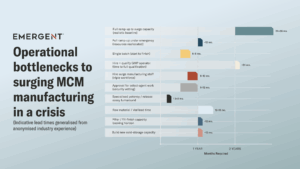
*Graphic from internal data on file – estimates based on Emergent’s previous experience.
Stockpiles can help protect society during a ramp-up
Surge manufacturing alone cannot defend Allied populations against a high‑consequence biological event on Day 1, or reasonably on Day 100. Allied governments have long recognized this in theory.
The U.S. Strategic National Stockpile was established to provide immediate access to countermeasures against threats such as anthrax, smallpox, and botulism when state and local resources are exhausted.17 Project BioShield was created to give industry a reliable, multi‑year demand signal for countermeasures with no commercial market.18 Canada’s National Emergency Strategic Stockpile plays a similar role at the federal level.19 At the multinational level, the European Union has begun expanding shared reserves through rescEU and investing in preparedness‑phase manufacturing capacity through initiatives such as EU FAB.15 NATO doctrine now explicitly treats CBRN medical countermeasures and casualty care as enabling defense capabilities.20
In practice, however, stockpiles are uneven, politically vulnerable, and expensive to sustain. They are not self‑renewing. Independent oversight bodies have repeatedly identified coordination and sustainment challenges within stockpile programs, including in the United States.21 When procurement is delayed or allowed to lapse, manufacturing lines cool, suppliers shift focus, and qualified personnel move on, lengthening the surge timeline for the next crisis.
The policy choice facing Allied governments is not between stockpiles and surge manufacturing, but how to integrate the two into a single, sustained capability. First, stockpiles must be treated as the non‑negotiable bridge to surge. The reserves must be adequately stocked to defend military and society during realistic manufacturing ramp‑up timelines rather than optimistic assumptions. Additionally, governments must preserve a warm industrial base, including the specialized workforce – this logic underpins preparedness phase manufacturing capacity initiatives such as EU FAB.15 Project BioShield in the United States uses steady, multi‑year procurement of biological countermeasures, even in peacetime to sustain needed capacity.9
Surge without stockpiles leaves populations and forces exposed for months or even years. Stockpiles without a warm industrial base leave governments unable to replenish or scale beyond the initial reserve. We must have both strategies in place to emerge from crisis successfully.
¹Kyiv Post, ‘Biological Terrorism’: Russia Burying Anthrax-Infected Livestock, June 23, 2026
²Notes from Poland, ASF-infected boar carcass was deliberately dumped and may be “eastern sabotage”, says Poland
³Filippa Lentzos, A decade of chemical and biological disinformation, mapped, Bulletin of the Atomic Scientists, 16 December 2025.
4SIPRI, SIPRI Yearbook 2025: Biological weapons and security threats, Oxford University Press, 2025.
5UK Government, Eroding norms and emerging threats: the evolving challenge of chemical and biological weapons, GOV.UK, 2025.
6European Commission, Preparing the EU for the next health crisis: A Medical Countermeasures Strategy, COM(2025) 529 final.
7NATO Military Committee, NATO’s Chemical, Biological, Radiological and Nuclear Defence Concept, IMSM 0198 2025, 15 July 2025.
8NATO Innovation Fund, First biotech investment to counter biological threats, 30 June 2025.
9Ministry of Defence, Finland to strengthen preparedness against CBRNE threats https://defmin.fi/en/-/finland-to-strengthen-preparedness-against-cbrne-threats
1oMaladies infectieuses émergentes et Menaces nucléaires, radiologiques, biologiques et chimiques; https://www.enseignementsup-recherche.gouv.fr/fr/maladies-infectieuses-emergentes-et-menaces-nucleaires-radiologiques-biologiques-et-chimiques-49220
11National Biodefense Strategy and Implementation Plan, October 2022, https://bidenwhitehouse.archives.gov/wp-content/uploads/2022/10/National-Biodefense-Strategy-and-Implementation-Plan-Final.pdf
12Public Health Agency of Canada, National Emergency Strategic Stockpile (NESS): Comprehensive Management Plan, July 2024.
13Global Preparedness Monitoring Board, The New Face of Pandemic Preparedness, 2025.
14OECD, Securing Medical Supply Chains in a Post‑Pandemic World, 2024.
15European Commission / European Health and Digital Executive Agency (HaDEA). EU FAB: Ever‑warm Vaccine Manufacturing Capacity. 2023–2025. https://hadea.ec.europa.eu/news/spotlight-eu-preparedness-projects-reinforcing-europes-resilience-changing-world-2026-01-13_en
16RAPS, Budget law calls for BARDA and FDA to establish “warm base” manufacturing, 16 January 2023.
17U.S. HHS / ASPR, Strategic National Stockpile.
18U.S. HHS / BARDA, Project BioShield.
19Public Health Agency of Canada, National Emergency Strategic Stockpile (NESS): Comprehensive Management Plan, July 2024.
20NATO Military Committee, NATO’s Chemical, Biological, Radiological and Nuclear Defence Concept, IMSM‑0198‑2025, 15 July 2025.
21U.S. Government Accountability Office, Strategic National Stockpile Coordination Challenges, GAO‑24‑106260, May 2024.
*Internal data on file – estimates based on Emergent’s previous experience.